
- PROPRIETARY INNOVATION // WO/2022/090212
VacTranS™
The ultimate tube transportation system in a high vacuum
Surpassing classical Hyperloop paradigms. By establishing an authentic high-vacuum regime where aerodynamic boundaries vanish, VacTranS unlocks frictionless terrestrial velocities of 1000 km/h and beyond.
CRUISING VELOCITY
m/s (3,600 – 7,200 km/h)
ATMOSPHERIC VACUUM
Knudsen Number > 1
EFFICIENCY METRIC
by energy recovery and photovoltaics along the track
CAPEX PROJECTION
of Classical High-Speed Rail
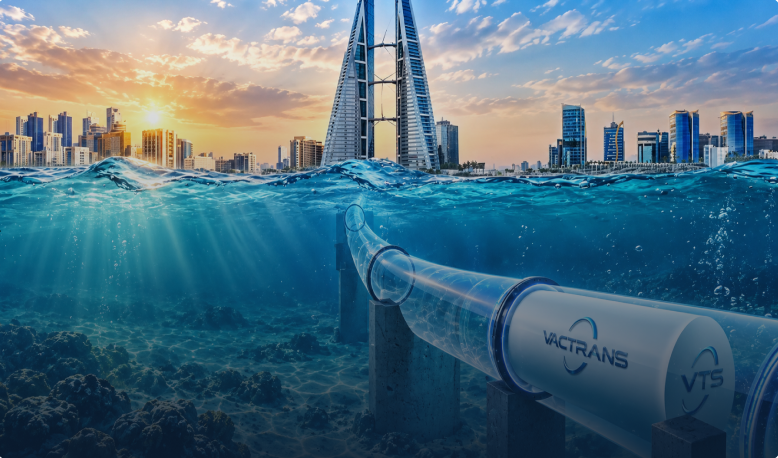
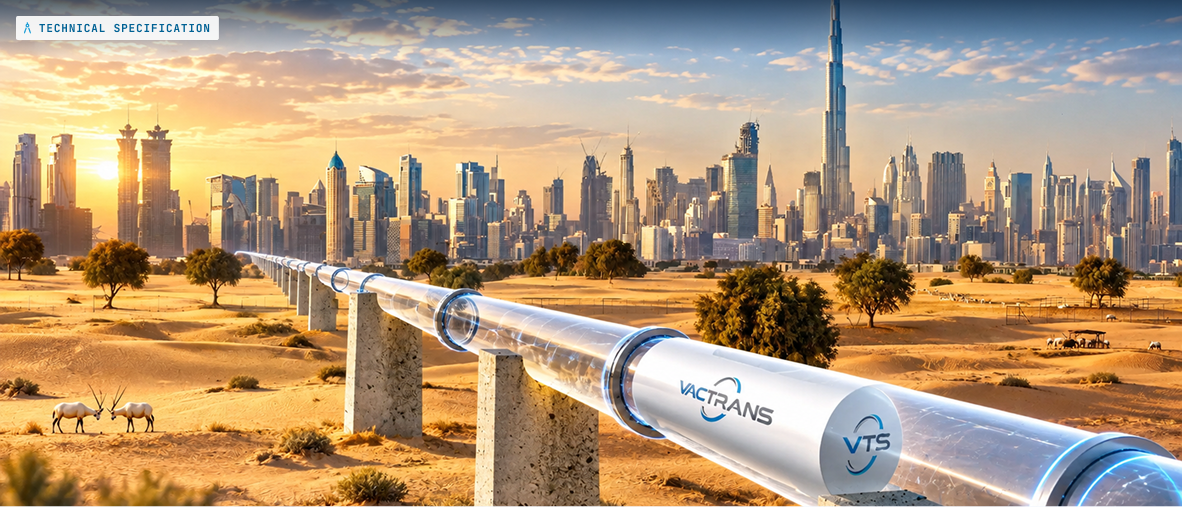
Evacuated Conduit Hyperloop Corridor & Station Terminal
Integrated multi-shell conduit architecture eliminating external atmospheric pressure gradients and guaranteeing continuous high vacuum.

Internal concentric tube arrangement (inner space 5) where vehicle annular clearance (11) is calibrated above the choking limit for seamless molecular rarefaction.
Patent & International Publication Details
PUBLICATION DATE
05.05.2022
INTL. APPLICATION NO.
PCT/EP2021/079655
INTL. FILING DATE
26.10.2021
IPC DATE
26.10.2021
B61B 13/10
B61B 13/122
Y02T 30/00
APPLICANTS
RUDOLF, Alexander [CH]/[DE]
INVENTORS
RUDOLF, Alexander · RUDOLF, Alain-Daniel
AGENTS
HARTZ, Nikolai F.
PRIORITY DATA
120420159 26.10.2020 SA
LANGUAGES
Publication: en | Filing: en
Saudi Arabia (SA)
27.02.2025 · Granted
European Union (EU)
03.12.2025 · Granted
Japan (JP)
08.04.2026 · Granted
United States (USA)
2026 · Notice of allowance issued
Canada (CA)
2026 · Expected
India (IN)
2026 · Expected
US, JP, CA, SA, IN
EU incl. CH, UK, TRK and SRB
VacTranS™ System Architecture & Concentric Evacuated Tube Blueprint
Engineering technical cross-section of the dual concentric guideway tube assembly showing annular boundary clearance calibrated above the choking limit for seamless molecular rarefaction.
Kn > 1 VALIDATED
minimal annular clearance
(only for lateral amortisation)
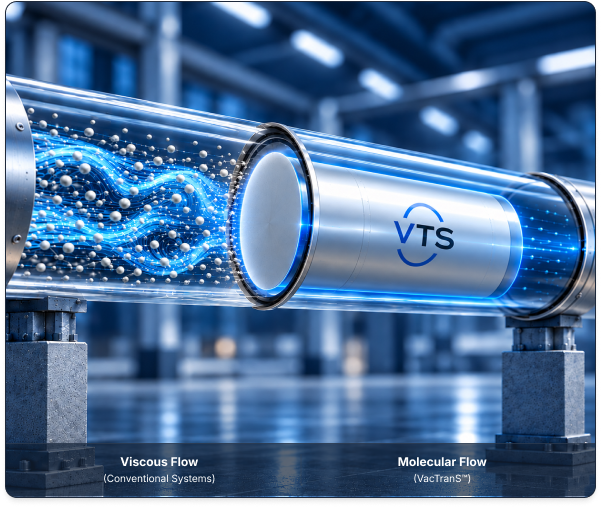
Molecular Flow for High-Speed Transportation
- VACUUM TECHNOLOGY
VacTranS™ operates in the molecular-flow regime, where extremely low pressure significantly reduces aerodynamic resistance. Unlike conventional systems based on viscous airflow, this approach enables higher speeds while allowing for a smaller tube diameter.
- High-vacuum operation
- Effectively no aerodynamic speed limit
- No aerodynamic effects during operation (molecular flow)
- Smaller tube diameter
- Molecular flow instead of viscous flow
- Lower propulsion requirements
Overcoming The Kantrowitz Limit &
Aerodynamic Paradox
Despite such a long history, distinct technical approaches, and significant efforts, it is not known that a high-speed tube transportation system has been realized. A major obstacle appears to be the aerodynamics.
So far, the common understanding is that the vehicle speed cannot exceed the “Kantrowitz Limit” (this term is used to refer to the first occurrence of choking) and that reducing the pressure does not remove the limit.
The method central for this invention (the VacTranS) is suitable and required to overcome these limitations. The VacTranS suggests to reduce the pressure level to the so-called high-vacuum regime.
While it is agreed that reducing and maintaining a high-vacuum is challenging, the aerodynamic problems of high-speed transportation in a partially evacuated tube is generally problematic.
In an attempt to reduce the far field aerodynamics, Rudolf (thesis 1806, EPFL, Switzerland, 1998) suggested the use of a turbine to push the air through the vehicle rather than having it accumulate ahead.
If compared to other inventions in this field, the VacTranS swaps the challenge of defying the aerodynamic under cruising conditions with the challenge to create and maintain a high vacuum.
In return, the method rewards with the following advantages:
- no aerodynamic effects during cruising,
- reduced and well predictable loads on the tube system
- smaller tunnel diameter
- increased stability of the system
- symmetrical arrangement of the linear induction motor
- reduced number of vacuum pumps and seals (or none at all)
- no aerodynamic speed limit
- smaller propulsion power and net zero energy consumption
- reduced travel times and
- smaller vehicles.
Moreover, emergency exits and stations are possible with no leakages and short evacuation or exchange times.
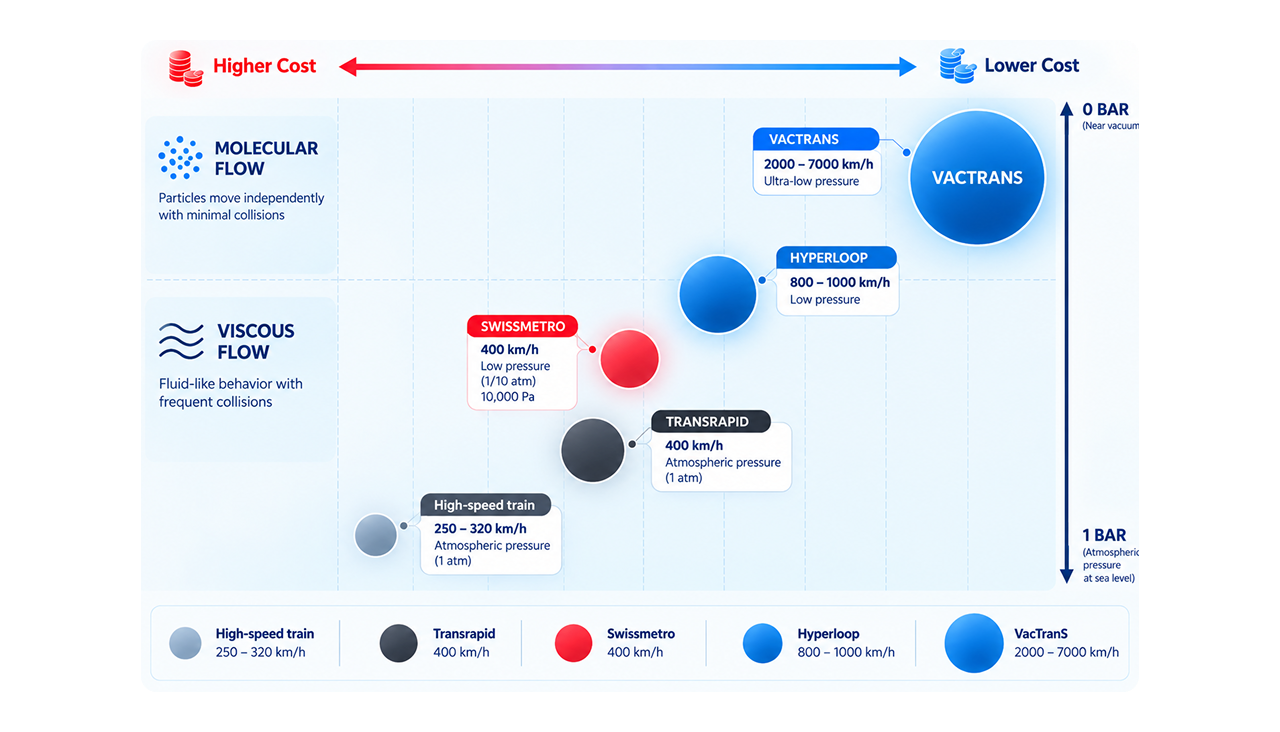
Evolution of High Speed Transport
Intercity Express
Transrapid
Hyperloop
Vactrans
ENGINEERING DEMOS &
PRESENTATIONS
Official technical talks, flow simulation tests, and vehicle scale models.
Main Features
Vehicles
While light, VacTranS vehicles are safe, compact and comfortable with VR for distraction.
Exits
Emergency exit possible at all locations with no leakages during normal operation.
Barrel
Revolving Barrel principle for stations safe and fast exchange of passengers with minimal leakages.
Speed
VacTranS can reach 1-2 km/s = 3600-7200 km/h.
A TUBE TRANSPORT SYSTEM FOR VERY HIGH VEHICLE SPEEDS AND A METHOD OF OPERATING A TUBE TRANSPORT SYSTEM
A method of operating a tube transport system, the tube transport system comprising (a) tube assembly comprising (a-1) an outer tube (1); (a-2) one or more inner tubes (2) received and held within the outer tube, each inner tube defining an inner space (5) for a vehicle to travel through; and (b) at least one vehicle (6) arranged to travel within the inner space, wherein the method comprises maintaining a high vacuum within the inner space such that the mean free path of the remaining gas molecules exceeds the characteristic dimension of the annular clearance between vehicle and inner tube.
Ready to design the future with VacTranS™?
Partner with VTS GmbH for municipal corridor feasibility, test-track commissioning, and high-vacuum transport licensing.